When making artwork
When making artwork
There are not many papers that directly study artists and creative coders, but the ones that exist say strikingly similar things. We go in order: what works, what breaks, and what sound and movement work is like.
Big leaps with words, fine adjustments by hand
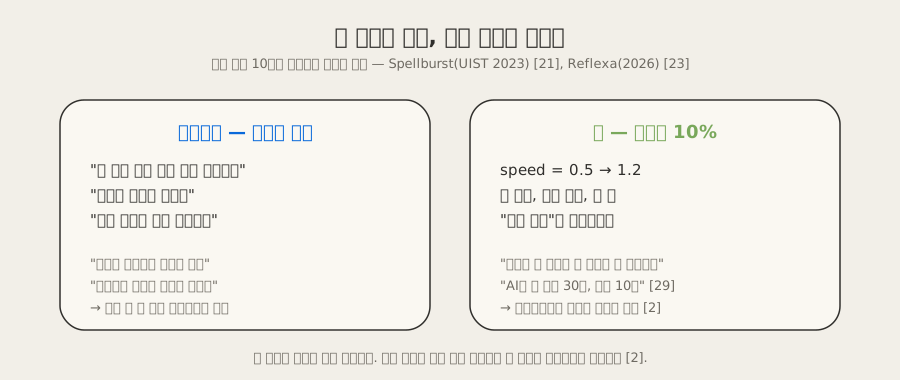
The earliest artist study is Spellburst (UIST 2023) [21]. The authors interviewed 10 generative artists, designers and game developers, then built and evaluated a node-based prompting environment on top of p5.js. The findings are clear.
- Prompts were good for big semantic jumps. Participants said they did not have to be very precise, and that they got part of the feeling they were after. Autocomplete took them down paths they had not even considered.
- But prompts were bad for small syntactic edits. When you know exactly what you want, wrestling with a chat is far more frustrating than coding directly. One participant felt there was a bit too much magic.
- The artists called their own practice "accident-driven development": a wrong connection made two shapes fuse in the middle, and those small accidents are the inspiration. And git clashed with exploration. The process, they said, is about seeing where things go more than planning ahead, and git demands too much planning. Instead they managed versions by duplicating files and taking screenshots ("versionFinalFinal.jpg").
- In the evaluation, what they liked most was branching and merging, more than the prompts. They explored many more ideas per minute and no longer had to fear losing a nice state.
The same conclusion recurs three years later in Reflexa (18 artists) [23]:
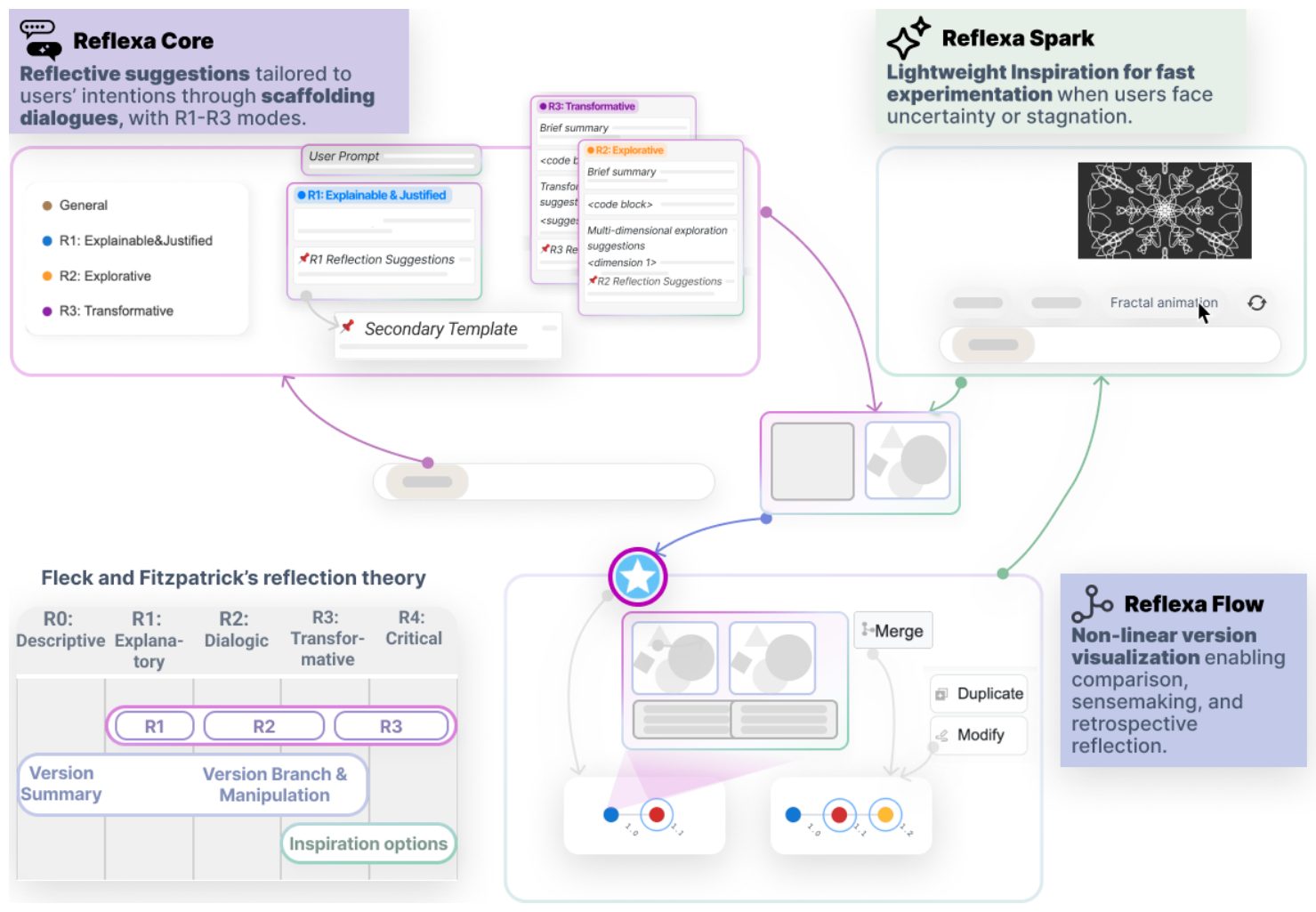
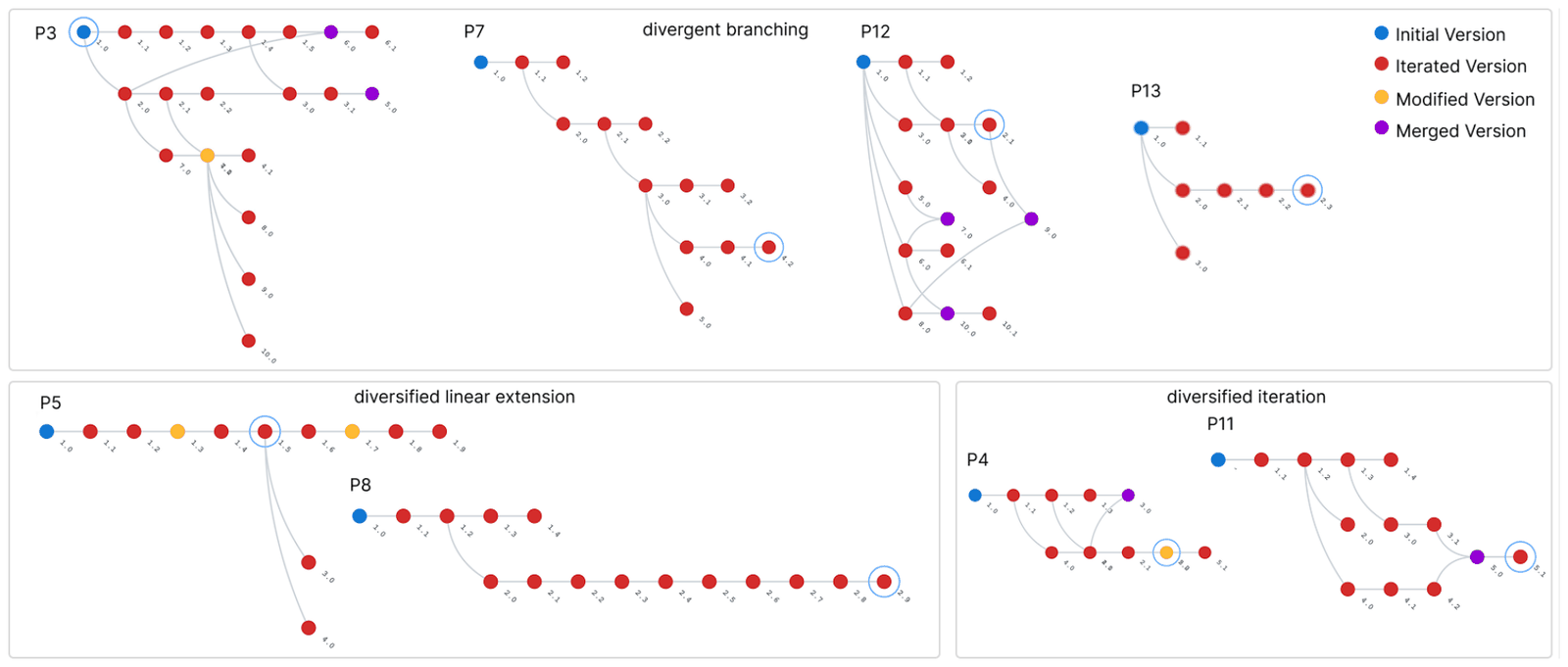
Ending with a single conversation leads to premature convergence, and stays with predictable results instead of conceptual depth. The unpredictability of LLMs can spark creativity, but it can also bring in irrelevant content that gets in the way of the goal. The solution was a version tree + asking for reasoning + variation prompts, and expert-rated originality and complexity went up. However, participants who relied heavily on AI stayed with prompt polishing or minor variations, and P5, who produced the best result, rebuilt the structure through rule changes led by the person (particles that avoid the mouse, regeneration).
Asking for everything at once shrinks ambition
An experiment with 22 art and design practitioners making interactive p5.js sketches [22]. In one condition they asked for the whole work in one prompt; in the other they split it into subtasks.
- Those who asked for everything at once wondered whether they had not been clear enough, since they thought the AI would understand, and found the result unchanged after rewriting five times. And they scaled back their ambition: this interaction is too hard, let's just do a static visual.
- Those who split the work had 1.5 times as many reflection episodes (222 vs. 147, p<.001): testing parameter hypotheses (0.5 is too slow, try 1), diagnosing conflicts, and reframing that changes the means while keeping the intent. What I wanted was a sense of fluidity, so particles instead of paths would work.
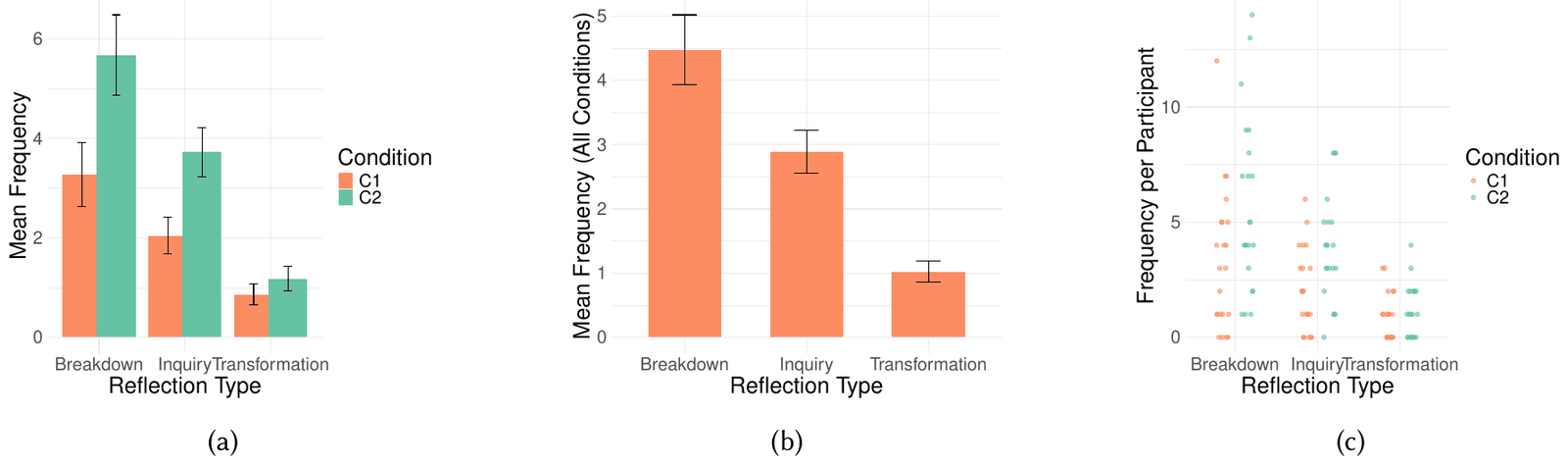
This is the artist-specific evidence for the first item in How to do it well, "break it down".
Anchoring on the first result
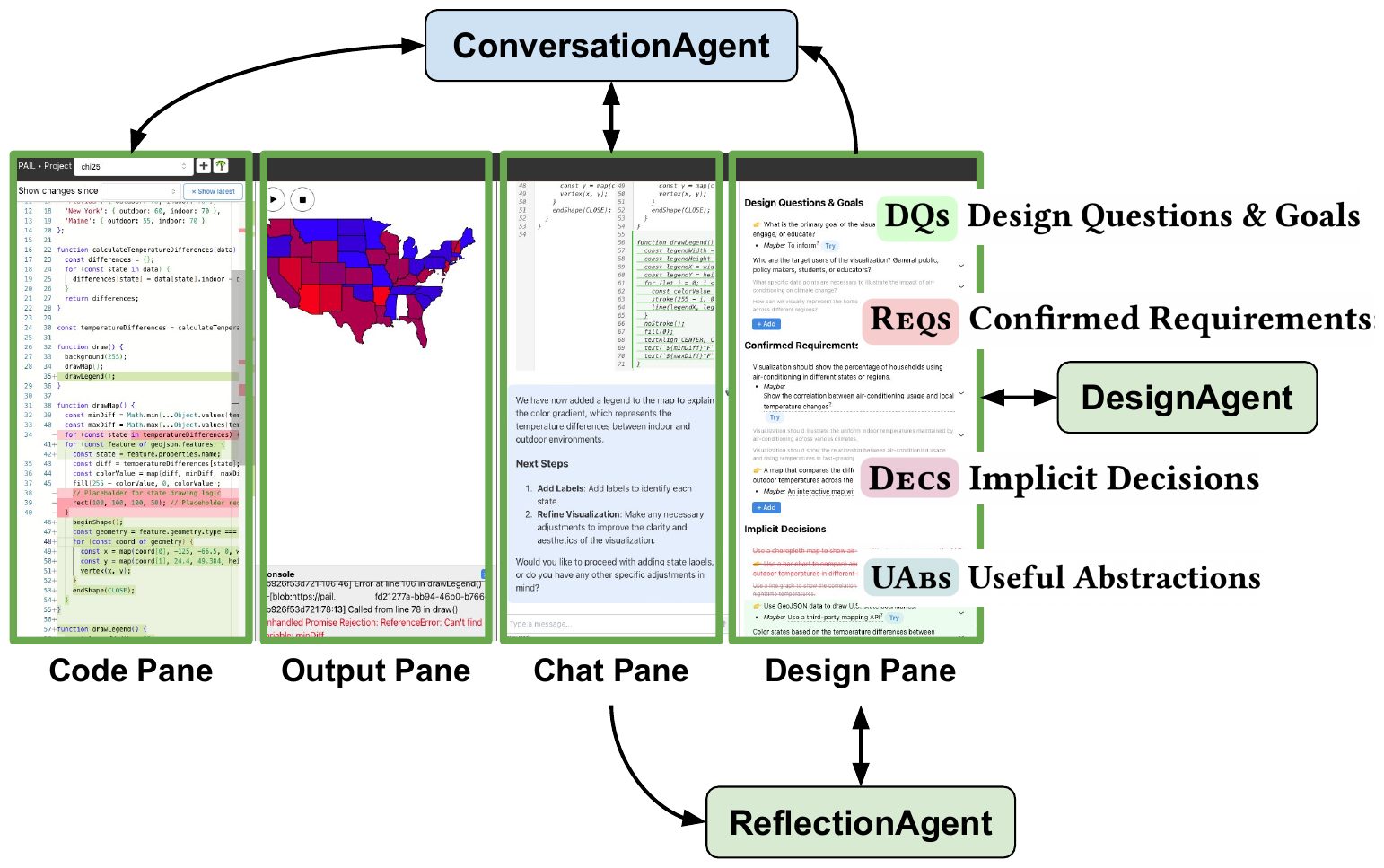
The Pail study at CHI 2025 [24] observed students who made p5.js work with ChatGPT and Claude over six weeks, followed by 11 people including media artists and sound artists.
- The model gives a single answer without discussing trade-offs, and people anchor on it.
- 7 of 11 stopped looking at the code entirely at some point, and the loop became run it, then ask the LLM to fix the error.
- When shown alternatives, 100% discovered alternatives they had not thought of, but none asked for them first. They preferred trying to explanation: show me, don't tell me.
- P8, an artist with a clear vision, rejected the reflection features, saying they did not care what the system said and just wanted to try the idea. That is a legitimate stance too. At such times the tool should stay quiet.
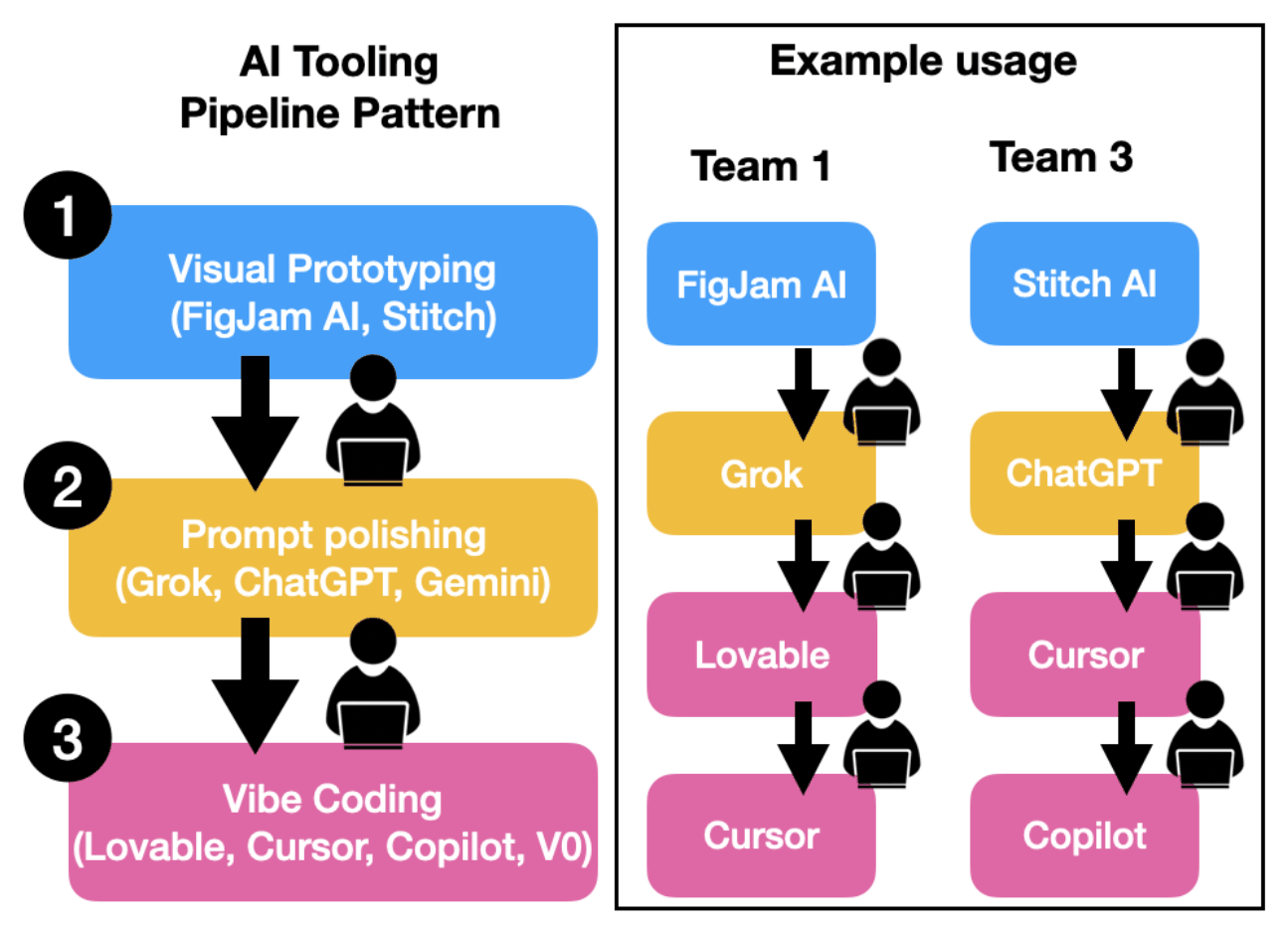
The same showed up at an education hackathon (31 people, including film, design and literature majors) [14]: 23 of 27 explored 5 ideas or fewer, and 40% made just one and polished it. And the UIs of all the apps were very similar, even the results of two teachers who used different tools and different prompts. The organizers' remedy: make three distinct concepts and prompt variations mandatory before committing.
The path of least resistance
The strongest controlled experiment [25]: 20 people each solved tasks with and without Copilot (these were not art tasks).
- With the LLM, solutions were more correct (32 vs. 18 correct out of 40), longer (71.7 vs. 50.6 lines) and less maintainable.
- Correct solutions were also more similar to each other, and the effect was largest in the tasks with the most freedom for creative exploration.
- Idea generation time got shorter and "aha" moments decreased (p=.01), even when time was left over. One participant described feeling pressure to just give up and ask for the answer when the LLM is there, since the brain takes the path of least resistance. Another felt you cannot be creative if the AI is good enough.
- Of four collaboration modes, the "Implementer" mode (the person supplies the idea and the LLM only types) had the most creative moments (49) and the highest share of unique ideas (0.72), while the "Brainstormer" mode, where the LLM led the ideation, had 4.
The authors' recommendation in one line: treat the LLM as an implementation accelerator, and keep idea generation for yourself. Be wary, they say, of tools that hand back an implementation when you asked for ideas. For an artist, this is a question of where to place the core of the work. As one Spellburst artist said in advance: they would not want to use it for the core, but could use it to amplify what they had just done [21].
The craft perspective
A design education study at TU/e [26] reads this situation through David Pye's "workmanship of risk / workmanship of certainty". At first they attached an unrestricted GPT chat, and learners reflected minimally and copy-pasted AI code. After revising the system prompt so that it gave only conceptual guidance and questions instead of answers, the AI took on the role of a translator of computational materiality, one that makes rules and structure visible without resolving the uncertainty. Participants wanted to gradually take over the lead from the AI, and said there was creativity in every parameter change.
A ten-year-old in a study with children [27] says the same thing more briefly: the AI is like a teammate who knows coding tricks, but the captain is me. 9 of 18 explicitly rejected AI suggestions, and one child asked about loop structure but wrote the variables themselves.
Homogenization
A paper that walked through 6 web vibe coding tools and analyzed 63 sources [28] gives a name to the problem of everything looking the same. The prompt (stage 1) and refinement (stage 4) are where the AI proposes homogenized designs and non-expert creators accept them, and the cause is the frictionless interaction itself, in addition to the training data: several stages of design and rendering collapse into a single instant event. The result is the "good enough trap": people accept the output because the cost of iterating against the model's defaults is too high, and less because it represents their own identity. Asked for a Japanese retail site, the tools produced minimal designs with lots of white space, and the model justified this as a "cultural preference". 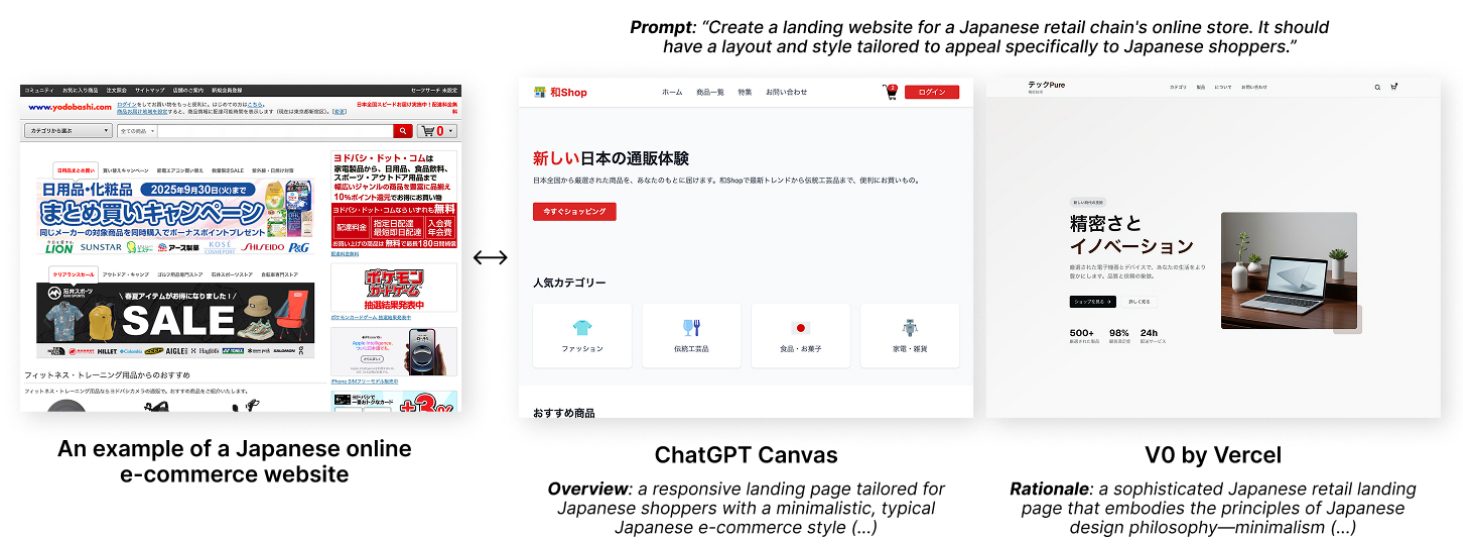
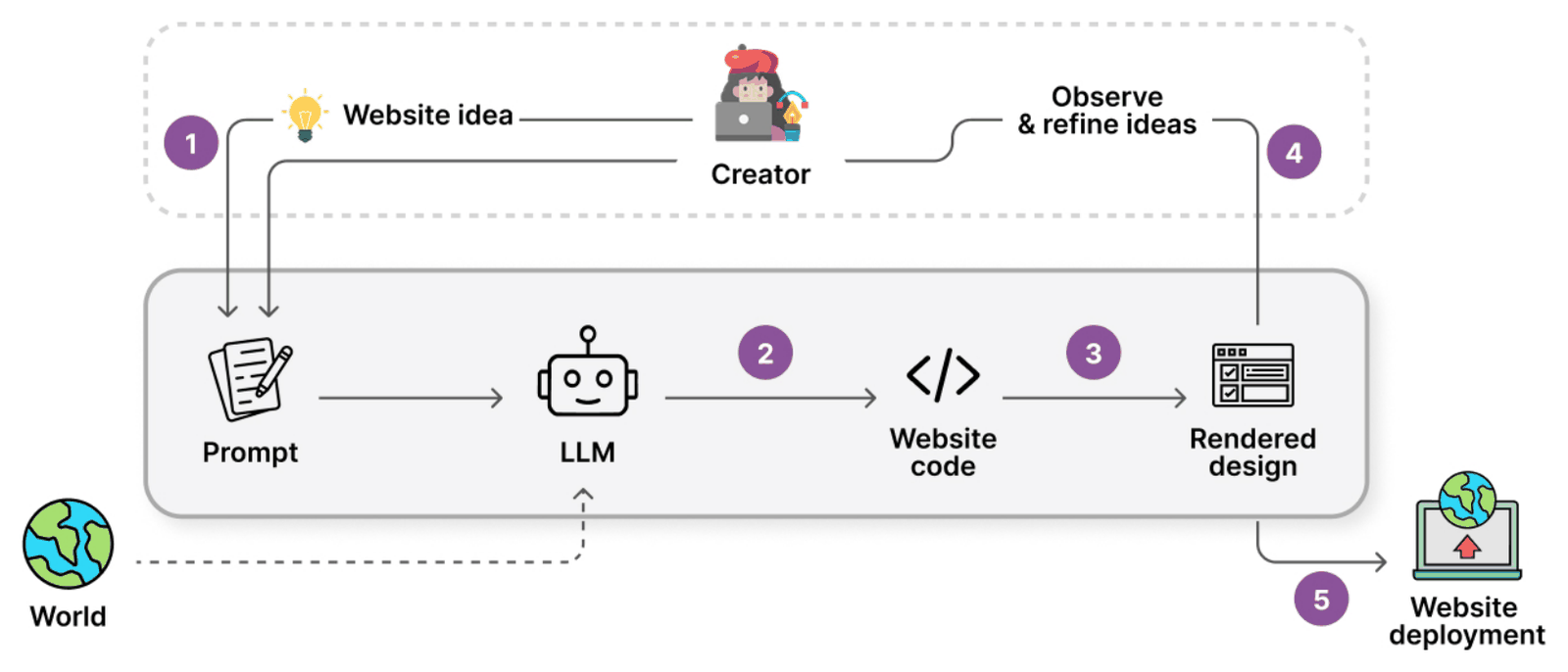
The remedy is "productive friction": treat the prompt as the start of a negotiation, make several mood boards before code, feed in reference material, and have the tool point out the "standard shadows and rounded corners" in generated results. In Cursor, you have to do this yourself.
People set direction, AI executes
20 experiments with 737 participants [17]. Lay people instructed GPT-5 in natural language to refine SVG animal drawings over 15 iterations.
-
When people led, quality rose after 15 rounds (+23%), and when the AI led itself, quality fell (r=−.23). Handing even part of it to the AI bent the trajectory, and people could not fully correct it afterward.
-
People's instructions averaged 17.7 words and were action-oriented: remove the tail, have the cat sit on its hind legs, make both front paws visible. The AI's instructions were 755-word descriptions, and limiting their length did not help. The problem was the eye for what is missing and what is wrong, more than length.
-
When people handled only the choice (keep/revert), the quality of the AI's instructions recovered. The design principle: people set the direction, and AI helps with evaluation and execution.
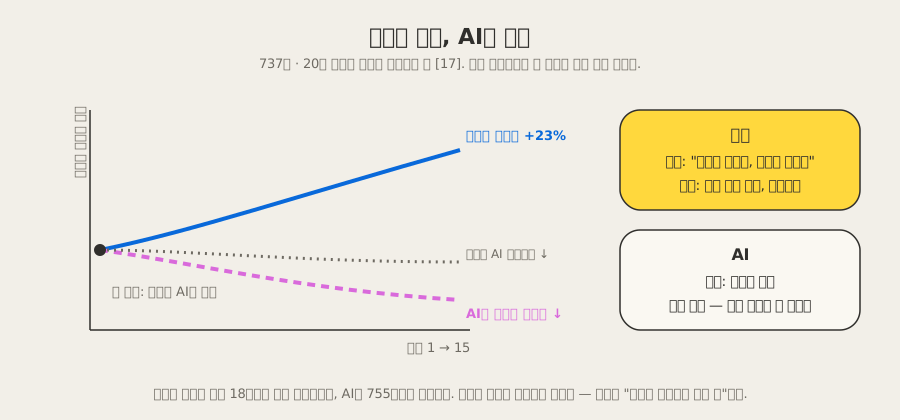
People set direction, AI executes: a diagram of the results of [17] (the axes are conceptual) -
When GPT-5 acted as the judge, it rated everything generously and preferred what the AI had made. Do not leave aesthetic judgment to the model.
In sound and movement work
Our first-day exercise connects sound and movement, so we gathered these separately.
-
LLMs cannot hear. In a check with 13,500 pairs of Sonic Pi code, the similarity of code embeddings had no correlation with the similarity of the actual sounds (Pearson 0.016). Slightly changed parameters produced code similarity above 0.99 and yet very different sounds, and the reverse also held [31]. "Three alternatives" can differ in text and sound the same. Make many candidates and choose with your ears.
-
Max/MSP users: generating patch JSON directly had an accuracy of 0.35, Python metaprogramming (MaxPy) 0.46, and Web Audio JS 0.76 [32]. The single line "use for loops and random()" doubled the number of nodes and produced "productive deviation", the way FM synthesis was once discovered. The paper also observes that for non-experts it is easier to regenerate broken code than to fix it.
-
Audio-reactive shaders: a system that takes a microphone or MP3 → a 32-band FFT → a single scalar
u_audioinjected into every shader, and has GPT-4 mutate and cross-breed a population of shaders [33]. A "world-class artist" role prompt gave bolder results, "preserve the structure" reduced compile errors, and sandbox compilation with 5 retries brought errors below 3%. The user acts only as curator, a trade that gives up understanding in exchange for access.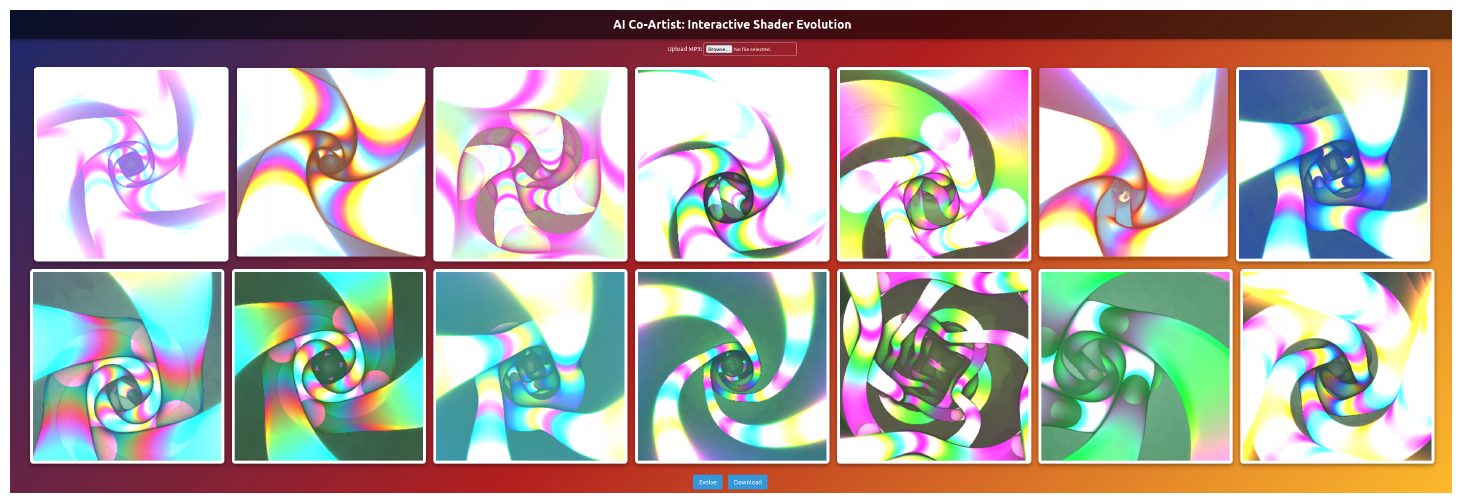
AI Co-Artist: a population mutated by GPT-4 from one chosen shader. All of them react to a single FFT value (u_audio) from the microphone or music. Source: Yuksel & Sawaf (2025) Fig. 2 [33], CC BY-NC-ND 4.0 -
XR and body interaction: Google XR Labs found that XR vibe coding fails because low-level sensor APIs and game engine layers do not suit LLM reasoning, and built a small vocabulary mapped 1:1 to natural-language concepts (user, hands, depth, physics). The pass rate rose from 70% to 95% [34]. The examples overlap with our interests: a dandelion that scatters when you pinch it, an origami horse that dances to the sound of my microphone. The lesson is that the choice of framework decides whether vibe coding succeeds, which is why we give Cursor small vocabularies like ml5 and p5.sound.
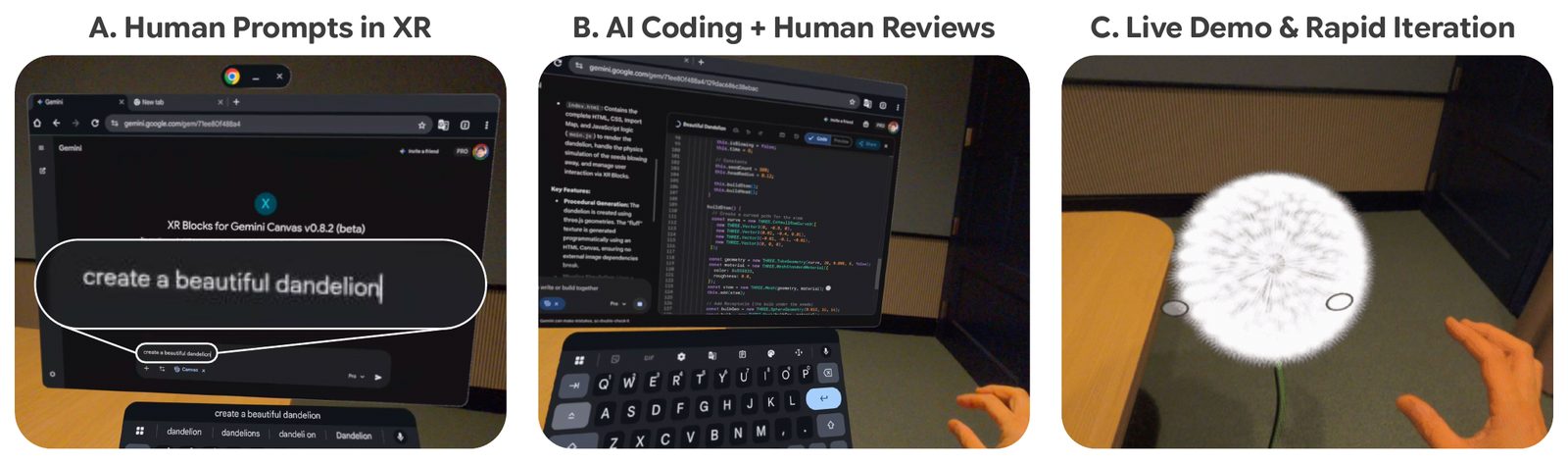
Vibe Coding XR: in a headset, "make me a pretty dandelion" → review Gemini's reasoning and code → a dandelion that scatters when pinched with the fingers. Source: Du et al. (2026) Fig. 1 [34], CC BY 4.0 -
Baseline statistics: of 1.61 million creative code repositories archived in Software Heritage, 70% are p5.js. Classifying 17,875 p5 sketches, 78% were time-based and 60% of those interactive, but only 6.6% synthesized sound [36]. Those of you working with sound are a minority, which also means the LLM has that much less training data.
In class
A voice from electronic literature
A rare text that theorizes vibe coding directly as a creative method appeared at ELO in 2026 [40]. Yohanna Waliya reads it as an affective mode of communication with AI, a poetics that takes rhythm, intuition and affect as central compositional principles and recycles existing digital texts, remediating them into poems and interactive animations. The claim that authorship is distributed across human creativity, algorithmic processes and existing digital material raises in advance the question that will come up in our critique.